
Best Kinesiology Tape for Arthritis Knees: a 5-Point Checklist Nobody Gives You
Written by: Brian Li, Co-Founder, Easy Kinesiology
Last updated: July 21, 2026
Where I'm coming from: I co-founded Easy Kinesiology, and we sell kinesiology tape. A "best tape" article from a tape company deserves your suspicion, so here's the deal: every medical statement below is cited to a real source, our own negative reviews are quoted verbatim, and the checklist works whether you buy from us or from a competitor. Judge it on that.
The best kinesiology tape for arthritic knees is the one you can physically get on, keep on through daily life, and return if your knee turns out to be in the minority it doesn't help. That sounds like a dodge. It isn't — arthritis changes the buying decision in ways the "top 10 tapes" lists never account for, because the hands doing the applying are often arthritic too.
Below: what the evidence honestly says, the 5 things that matter when you're choosing, and the failure patterns we pulled from the verified reviews of our own product — including the ugly ones.
Does kinesiology tape help arthritic knees at all?
Short version: the evidence is real and it is modest. Both things at once.
The American College of Rheumatology gives kinesiology taping a conditional recommendation for knee and hand osteoarthritis. Cleveland Clinic orthopedic surgeon Dr. Dominic King notes it's considered most effective for osteoarthritis at the front of the knee, underneath the kneecap, and that "the risk for harm is extremely low."
Two trials are worth knowing about. A 2017 study of 42 people with knee osteoarthritis found kinesiology tape brought better pain relief, improved walking, and improved knee-flexion range of motion compared with placebo tape. A larger 2019 study — 141 participants wearing tape for 3 consecutive days — reported reduced pain and joint stiffness and improved knee function versus sham taping.
Now the honest part. "Conditional recommendation" is rheumatology-speak for worth trying, evidence not strong enough to promise anything. These are small studies measuring short windows. Kinesiology tape does not cure, treat, or heal arthritis — no tape does, and any page telling you otherwise is lying to you. What the research supports is narrower: for some people, taping makes an arthritic knee more comfortable to move on. That's the claim. Nothing bigger.
Why is buying tape different when arthritis is the reason?
Every "best kinesiology tape" list on the internet is written for athletes — which tape survives a marathon, which colors look good at CrossFit. Arthritis flips the problem.
With arthritic knees, tape is a two-joint purchase. There's the knee the tape goes on. And there are the hands that have to tear open the package, peel a stubborn plastic backing off a sticky strip, and place it smoothly — hands that may have arthritis themselves. Our review data says the second joint decides more purchases than the first.
Three other differences that change what "best" means:
- Your skin is part of the decision. Skin gets thinner and more delicate with age and with some arthritis medications. Adhesive strength cuts both ways.
- You're wearing it through life, not an event. Showers, sleep, long days, slacks and jeans rubbing against it — a tape that survives one soccer match can still fail by Tuesday.
- You might be a non-responder. The studies above had people who didn't improve. A brace-and-forget purchase this is not; you're running a test on your own knee, and the smart buy is the one that makes that test cheap.
That's the logic behind the checklist.
The 5-point checklist for choosing arthritis-friendly tape
1. Can you physically apply it — with your hands, on your worst day?
This is the deciding criterion and the one no ranking list mentions. The most common complaint in our own reviews has nothing to do with whether the tape works on the knee. It's the backing.
Beverly Hall, one of our customers: "it is very difficult to get the backing off to apply. I am a senior… I end up with more clumped up tape before I can get it placed." Lisa Ito: "hard to take off the backing from the tape." Eleanor Damico: "Must be applied perfectly or it twists."
Those are our reviews. We make a pre-cut tape engineered for stiff fingers, and stiff-handed customers still sometimes struggle. A roll of tape you have to measure, cut with scissors, round the corners on, and peel — with arthritic thumbs — is a harder ask again. CreakyJoints' advice for arthritic hands is to have someone else in your household apply it, which works if that someone exists. If you live alone, buy the format you can manage alone.

What to look for: pre-cut strips (no scissors), a backing designed to start peeling from a corner or split, and a shape that doesn't demand surgical placement. If your hands are the bottleneck, watching it done helps more than reading about it — every knee application is demonstrated on camera on the video tutorials page.
2. Will it stay on through real life — and what does "days" honestly mean?
Here's where I have to rat out my own marketing. Our packaging says the tape stays on up to 7 days. Our reviews most often confirm 2 to 3. Laurie Juskiewicz: "Lasts two days through all movement and is the best I have found. I have tried many brands and this one lives up to its claims." Diana Noad got three days on an arthritic knee. Nobody writes in about day seven.
Treat every brand's wear claim the same way — as a ceiling measured under friendly conditions, not a promise. CreakyJoints puts typical wear at three to five days, which matches what physical therapists tell patients.
And sometimes tape fails early. Teffney Shearer: "Tape does not stick to the skin well at all. Within 30 mins the ends start to roll up." Kathy Harvey: "within an hour under my slacks they have rolled up in a ball." Rolling ends are usually a skin-prep issue — lotion, oils, or moisture under the adhesive — but not always, and a brand that blames every failure on user error is a brand hiding its return rate.
What to look for: water-resistant adhesive rated for showers ("it stays on in water and when it's hot outside and your knees sweat" — Paige Harvey), rounded or diamond-shaped ends that resist rolling under clothes, and a brand that tells you the review-confirmed wear time, not only the lab number.
3. What's actually touching your skin?
One of our customers, Robert Zuniga, asked a question more buyers should ask: "my body felt funny once applied. Is there side effects? I didn't see any ingredients or warning labels?"
For a product that sits on aging skin for days, the label matters. Look for: latex-free (latex allergy is common and latex adhesives are harsh), a high cotton content that breathes (ours is 95% cotton, 5% elastane), and a hypoallergenic adhesive — while remembering hypoallergenic means "less likely to irritate," never "cannot irritate." pamela stith's review is the outcome you want: "Easy to use and my skin doesn't itch."

Two cautions that apply to every brand, ours included. Don't tape over broken, fragile, or rashy skin. And patch-test first: stick a small piece on your forearm for a day before trusting a full strip to your knee. If you know your skin is reactive, look for a sensitive-skin version — we make one, and so do others.
4. What happens if you're one of the people it doesn't help?
Andrew Ricks Jr, verbatim, from our reviews: "this tape did not work for me… and the fact that it's hard to apply maybe the bigger issue."
He's in the minority of our verified reviews — the average sits at 4.7 stars — but he's real, and the research says he has company. A conditional recommendation means responders and non-responders both exist, and no brand can tell you in advance which you are. The evidence on that split — and a three-week self-test to find out which side your knee lands on before you've spent much — is in does kinesiology tape work for knee pain.
So make the guarantee a buying criterion. Not the marketing kind — the kind with a number and a mechanism. Ours is a 100-Day Money-Back Guarantee, which exists precisely because of the Andrew problem: you're testing whether taping suits your knee, and a test you can't get out of is a bad bet. Whatever brand you pick, check the return window before you buy, and check whether opened product qualifies. A 30-day window on a tape you wear 3 days at a time gives you about seven wears to decide.
5. What does a month of taping cost?
Tape is a consumable. The sticker price matters less than the price per wear.
The math: strips per box ÷ wears per week. One of our customers, Kem Blalock, called us out here — "States it is a 30 day supply but there is only 15 strips in the box." Fair hit: 15 strips is a 30-day supply at 2–3 days of wear per strip, and if your tape peels on day one, the same box lasts half as long. That's another reason wear time (criterion 2) is a money question, and another reason pre-cut beats rolls for arthritic hands specifically — a mis-cut strip off a roll goes in the trash.
Run the numbers on any brand: box price ÷ strips = cost per application; then multiply out a month at your realistic wear time. A cheaper box that stays on 1 day usually loses to a pricier box that stays on 3.
What did our verified reviews teach us about arthritic knees specifically?
Beyond the failure patterns above, the arthritis-specific picture from our review base:
The buyers this helps tend to describe the same starting point — knee pain interrupting walking, stairs, and sleep, often with medication already in the picture. Susan Smith, 65: "I have an IT injury along with arthritis in both knees… I was on oral steroids, anti inflammatory and narcotic medications. The pain… was awful. It was affecting my ability to enjoy my life." She went on to write, "I order these strips in a moment of desperation… No BS it's like a miracle. I can not begin to explain the relief!!" Results may vary — and I want to be blunt: her experience is a best case, not a typical one. Most positive reviews sound like Diana Noad's: "The tape was easy to apply and lasted three days on my knee. It was also easy to take off. I felt that it helped to alleviate the OA pain in my knee." Comfortable, useful, undramatic. Results may vary.

The repeat-purchase pattern is the signal I trust most. Sharon Wilson: "This is my second time ordering. I've been using the tape on my knee for several months. It definitely makes a difference." Ken Thompson, on his wife: "supports her knees and really helps with the popping and movement which causes her pain. Highly recommend… we never want to run out." Skeptics show up too — Brittany Boger: "I was a little skeptical of this product, but when I put it on my knee, it definitely made it feel better." Results may vary.
And some people it didn't help, per section 4. We keep those reviews published. You should distrust any tape brand whose review page shows nothing under 4 stars.
Where does Easy Tape fit — and where might it not?
Full disclosure again: this is our product.
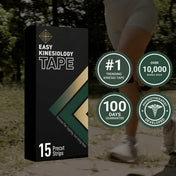
Easy Tape scores on this checklist the way you'd expect, because the checklist and the product came from the same place — the same review complaints and the same buyers. Pre-cut patented diamond-shape strips, no scissors, engineered for stiff fingers (criterion 1). Review-confirmed 2–3 day wear through showers and sweat, brand-rated up to 7 (criterion 2, both numbers, take your pick). Latex-free, hypoallergenic, 95% breathable cotton, sensitive-skin version available (criterion 3). 100-Day Money-Back Guarantee (criterion 4). 15 pre-cut strips per box, so the per-month math is predictable (criterion 5). The product page is here — read it with the checklist open. It was designed by PT. Cheng-Lin Sung, a physiotherapist with 14 years of clinical practice — he designed the product; he didn't write or review this article.

Where it might not fit: if you want brace-level rigidity and compression, tape is the wrong category for you entirely — tape supports and cues movement, it doesn't immobilize. If your skin reacts to every adhesive you've ever tried, test carefully or skip taping. And if application defeats you even in pre-cut form, the honest answer is the CreakyJoints one — a second pair of hands, or a different tool.
What about KT Tape, RockTape, and the other big names?
They're real products from real companies, and for athletes they're often the right call — rolls let you cut custom shapes for shoulders, ankles, and elaborate multi-strip patterns that pre-cut can't match.
For arthritic knees, run them through the same 5 points, and note one option we can't offer: K-Tape My Skin comes in multiple skin tones, which CreakyJoints highlights and which matters if visible beige tape bothers you. None of the big athletic brands, to my knowledge, designs its backing or shape around arthritic hands — that gap is the reason our product exists. But "check the label, check the return policy, do the per-wear math" applies to every box on the shelf, including ours.
The side-by-side, on the things you can check from outside the box:
| Easy Tape | KT Tape / RockTape | K-Tape My Skin | |
|---|---|---|---|
| Format | Pre-cut diamond strips | Rolls and pre-cut strips | Roll |
| Designed around arthritic hands | Yes — tear-at-the-cut backing, no scissors | Not that we know of | Not that we know of |
| Skin-tone options | No | No | Yes — multiple tones |
| Wear claim vs. reality | Rated up to 7 days; our reviews most often say 2–3 | Check reviews, not the box — typical wear runs 3–5 days per CreakyJoints | Check reviews, not the box |
| Return window | 100-Day Money-Back Guarantee | Varies — check before buying | Varies — check before buying |
How do you try kinesiology tape without wasting money?
- Ask your doctor or physiotherapist first — especially with fragile skin, circulation problems, or blood thinners. Both Cleveland Clinic and CreakyJoints suggest having a PT or occupational therapist show you the application once; most people can manage it themselves after that.
- Patch-test the adhesive on your forearm for a day.
- Buy one box, not a subscription, from a brand with a real return window.
- Apply it properly — clean, dry, lotion-free skin, and follow a knee-specific guide: how to apply kinesiology tape to your knee.
- Give it a fair test, then decide. A few weeks of honest wear tells you which group you're in. If it hasn't helped, use the guarantee — that's what it's for.
If you're reading this for a parent, or your own hands are the obstacle, the senior-specific guide covers the application barrier in depth: kinesiology tape for seniors. And if you're a step earlier — still deciding whether tape belongs in the plan at all — start with the complete guide to kinesiology tape for knee pain, which walks the evidence, the choosing criteria, and the application method in one place. And once the tape is in hand, how to tape a knee for arthritis adapts the application for older skin and stiffer hands.
Medical disclaimer
This article is for general information only and is not medical advice. It is not a diagnosis, and it is not a substitute for care from a qualified healthcare professional. Kinesiology tape does not cure, treat, or heal arthritis, osteoarthritis, or any other medical condition. Talk to your doctor or physiotherapist before starting any new approach to knee pain, especially if you have thin or fragile skin, circulation problems, or take blood-thinning medication. Individual results vary.
About the author
Brian Li is the co-founder of Easy Kinesiology, which makes Easy Tape — the conflict of interest in a "best tape" article from a tape company is disclosed at the top and repeated here. He is not a medical professional. The tape discussed was designed by PT. Cheng-Lin Sung, a physiotherapist with 14 years of clinical practice; he did not contribute to or review this article. Medical statements above are attributed to the cited sources, not to the author or the brand.
References
- "Can Kinesio Tape Help with Osteoarthritis?" Cleveland Clinic (featuring Dominic King, DO). https://health.clevelandclinic.org/can-kinesio-tape-help-with-osteoarthritis
- "Can kinesiology tape help knee arthritis?" Medical News Today (medically reviewed by Angela M. Bell, MD, FACP). https://www.medicalnewstoday.com/articles/kt-tape-knee-arthritis
- 2017 randomized trial, n=42: kinesiology taping vs placebo tape in knee osteoarthritis. https://pubmed.ncbi.nlm.nih.gov/27149590/
- 2019 randomized trial, n=141: 3-day kinesiology taping vs sham in knee osteoarthritis. https://pubmed.ncbi.nlm.nih.gov/29466081/
- "Kinesiology Tape for Arthritis: Does It Help Treat Pain and Stiffness?" CreakyJoints / Global Healthy Living Foundation. https://creakyjoints.org/living-with-arthritis/kinesiology-tape-arthritis/
Customer quotes are verbatim from verified purchase reviews (4.7-star average). Nothing here is paraphrased or composed.