
Kinesiology Tape for Knee Pain: A Complete Guide for Older and Arthritic Knees
Written by: Brian Li, Co-Founder, Easy Kinesiology
Last updated: July 22, 2026
Where I'm coming from: I co-founded Easy Kinesiology, and we sell kinesiology tape. So read this the way you'd read any guide written by a company that wants your money — with your guard up. Here's my side of the bargain: every medical claim below is cited to a real source, the mechanism is described as the unproven theory it still is, and our own worst reviews are quoted word for word. If a tape company won't show you its one-star reviews, that tells you something.
Kinesiology tape is a stretchy cotton-and-elastic strip you stick over the knee to support the joint while you keep moving — and for knee pain the honest bottom line is this: the evidence says it helps some people a modest amount, it helps nobody by curing anything, and whether it helps you is a test you run on your own knee. That is a smaller promise than most pages make. It's also the true one.
Almost every "kinesiology tape for knee pain" guide online is written for athletes or written by a hospital covering the topic in general. This one is written for the reader who buys the most tape for knee pain: an older adult, often with arthritis, who wants to walk, do the stairs, and get through the day without a medical project. That reader has different questions, and this guide answers them in order — does it work, how is it supposed to work, what kind of knee pain it suits, how to choose, how to put it on, and what our own verified reviews say happens.
What is kinesiology tape, and how is it supposed to work on the knee?
Kinesiology tape is a thin, elastic cotton tape with an adhesive back. Unlike rigid athletic strapping that locks a joint down, it stretches roughly like skin does, so you can bend and straighten the knee while wearing it. That is the whole design idea: support without immobilizing.
How it works is where honesty matters. The common explanation — the one brand pages state as fact — is that the tape lifts the skin slightly to take pressure off the tissue underneath, nudges the kneecap to track better, and changes the sensory signals your knee sends while you move. That is the theory, and it's a reasonable one. But it is still a theory. The research has not settled on a single proven mechanism, and any page that describes exactly how the tape "fixes" your knee is telling you more than science knows. What is fair to say, in plain structure-function terms: the tape supports the area and cues movement mechanically, without any drug or chemical. It does not enter your body and it does not change the arthritis in the joint.
Does kinesiology tape actually work for knee pain?
The short answer: the evidence is real, and it is modest. Both at once.
Cleveland Clinic's review of the evidence notes the American College of Rheumatology gives kinesiology taping a conditional recommendation for knee and hand osteoarthritis. As Cleveland Clinic orthopedic surgeon Dr. Dominic King explains, taping is considered most effective for osteoarthritis at the front of the knee, under the kneecap, and "the risk for harm is extremely low." A conditional recommendation is rheumatology-speak for worth trying; the evidence isn't strong enough to promise a result.
A few trials give you the shape of it. A 2017 study of 42 people with knee osteoarthritis found taping brought better pain relief, better walking, and improved knee-flexion range of motion than placebo tape. A larger 2019 trial — 141 people wearing tape for three straight days — reported less pain and stiffness and better function versus sham taping. A small 2019 study in older adults with knee OA found an immediate effect on pain and gait after application.
Now the caveats. Those are three small trials measuring days and weeks, not years — and the same Cleveland Clinic article is blunt about the ceiling: "there isn't enough high-quality evidence to make a strong recommendation," and "there are experts who doubt its effectiveness." Some knees respond, some don't, and no test exists to tell you in advance which yours is. Kinesiology tape does not cure, treat, or heal arthritis or any knee condition. What the evidence supports is narrower and worth having anyway: for many people, taping makes an arthritic or aching knee more comfortable to move on for a couple of days at a time. That's the claim. Anything bigger is marketing. For the deep dive on exactly that question — the full trial evidence laid next to our own verified reviews, including the buyer our tape did nothing for — see does kinesiology tape work for knee pain.
Why is choosing tape different when you're older or have arthritis?
When arthritis is the reason you're taping, tape becomes a two-joint purchase. There's the knee the tape goes on. And there are the hands that have to open the package, peel a stubborn backing off a sticky strip, and place it smoothly — hands that often have arthritis themselves. In our review data, the second joint sinks more purchases than the first.
Three more things change what "best" means once you're past the athlete demographic:
- Your skin is part of the decision. Skin tends to get thinner and more delicate with age, so adhesive strength cuts both ways — too weak and the tape rolls off, too aggressive and it can irritate. If you take a medication that affects your skin, ask your pharmacist or doctor before taping.
- You wear it through life, not through an event. Showers, sleep, long days, trouser legs rubbing against it. A tape that survives one tennis match can still fail by Tuesday.
- You might be a non-responder. Cleveland Clinic's hedge above is there for a reason — some knees respond and some don't. No brand can tell you in advance which group you land in, so the smart buy is the one that makes finding out cheap.

Two full guides go deeper than this pillar can. If arthritis is your specific reason, the best kinesiology tape for arthritis knees breaks the choice into a five-point checklist. If the application barrier is the real worry — yours or a parent's — kinesiology tape for seniors covers the stiff-hands problem in depth. And if the words you walked out of the appointment with were "bone on bone," what bone on bone really means explains the phrase before anything else on this page.
What kind of knee pain does taping suit — and when should you skip it?
Taping is a general-purpose comfort tool for a few common patterns of nagging, non-emergency knee pain:
- Osteoarthritis / "wear and tear" aches — the biggest use case, and the one with the evidence above. And if you're weighing tape against every other drug-free option for an arthritic knee — exercise, weight loss, tai chi, a brace — our drug-free options, ranked by evidence shows where tape honestly sits in that lineup.
- Kneecap and front-of-knee pain — where taping is considered most effective, per Cleveland Clinic.
- General soreness from being on your feet, walking, or the stairs — the everyday complaint most of our buyers describe.
It isn't the right tool for every knee problem, and this is the part I won't soften. See a doctor or physiotherapist first — not a tape guide — if your knee is hot, red, or badly swollen, if it locks or gives way, if the pain came from a specific injury or fall, or if it's severe or getting worse. Tape is for the achy, manageable knee you want to keep moving. It is not a diagnosis and it is not treatment. If you take blood thinners or have thin, fragile, or reactive skin, ask your clinician before you tape at all.
How do you choose a kinesiology tape for your knee?
Run any brand — ours included — through five plain questions instead of trusting the box:
- Can you physically apply it, on your worst hands day? Pre-cut strips beat rolls-and-scissors for arthritic hands. In our reviews, this decides more purchases than any other criterion.
- Will it stay on through real life? Treat every wear claim as a ceiling, not a promise, and look for the review-confirmed number.
- What's touching your skin? Latex-free, breathable, hypoallergenic — and patch-test regardless.
- What if it doesn't help you? Check the return window before you buy. Non-responders are real.
- What does a month cost? Price per wear, not sticker price: strips per box ÷ wears per week.
The arthritis buying guide walks all five with the review data behind each. The short version: match the format to your hands and the return policy to your uncertainty.

How do you apply kinesiology tape to your knee?
The basics, in brief: start with clean, dry, lotion-free skin. Anchor the tape without stretch at the ends, apply the middle with light-to-moderate stretch depending on the pattern, and rub it firmly for a few seconds so the adhesive activates with your body heat. Round or diamond-shaped ends resist rolling under clothes. Don't yank it off — peel it slowly, in the direction of hair growth, ideally after a warm shower.
That's the outline, not the method. For the step-by-step with photos and the pre-cut shortcut for stiff hands, follow how to apply kinesiology tape to your knee. If watching helps more than reading — and for a lot of arthritic hands it does — every knee application is demonstrated on camera on the video tutorials page. Cleveland Clinic and CreakyJoints both suggest having a physiotherapist or occupational therapist show you the application once; most people manage on their own after that.
What do our verified reviews say goes wrong (and right)?
This is the data the rest of the SERP doesn't have. Across our verified purchase reviews (4.7-star average), a few patterns show up that no generic guide will tell you.
Wear time is shorter than the box says. Our packaging rates the tape up to 7 days. Reviews most often confirm 2 to 3. Laurie Juskiewicz: "Lasts two days through all movement and is the best I have found. I have tried many brands and this one lives up to its claims." Diana Noad got three days on an arthritic knee. Treat every brand's number the same way — CreakyJoints puts realistic wear at three to five days. Results may vary. For the deep dive — every published range against what real knees get, and the fixes that extend wear — see how long kinesiology tape stays on.
The backing is the real fight, not the knee. Beverly Hall: "it is very difficult to get the backing off to apply. I am a senior… I end up with more clumped up tape before I can get it placed." We make a pre-cut tape built for stiff fingers, and some stiff-handed customers still struggle. A roll you have to cut and peel with arthritic thumbs is harder again.
Sometimes it fails early, and sometimes it fails a person. Teffney Shearer: "Within 30 mins the ends start to roll up." Rolling ends are usually a skin-prep problem — lotion or moisture under the adhesive — but not always. And Andrew Ricks Jr., verbatim: "this tape did not work for me… and the fact that it's hard to apply maybe the bigger issue." He's in the minority, but he's real, and the research says he has company.

The signal I trust most is repeat buyers. Sharon Wilson: "This is my second time ordering. I've been using the tape on my knee for several months. It definitely makes a difference." Ken Thompson, about his wife: "supports her knees and really helps with the popping and movement which causes her pain… we never want to run out." Linda Carman: "These tapes have eased my pain and allow me to walk comfortably for a longer period of time!" Results may vary — and to be blunt about the strongest stories: Susan Smith, 65, on steroids and anti-inflammatories for arthritis in both knees, wrote "I can not begin to explain the relief." That's a best case, not a typical one. Most happy reviews sound like Diana's: comfortable, useful, undramatic.
Where does Easy Tape fit — and where might it not?
Full disclosure again: this is our product, so weigh it accordingly.
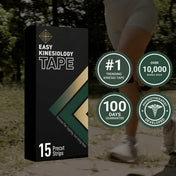
Easy Tape is pre-cut in a patented diamond shape — no scissors, engineered for stiff fingers. The material is a 95% cotton, 5% elastane weave, latex-free and hypoallergenic, with a sensitive-skin version if your skin runs reactive (our sensitive-skin guide covers patch testing and the irritation-vs-allergy difference). On staying power, I'll let two buyers speak. Paige Harvey: "it stays on in water and when it's hot outside and your knees sweat." pamela stith: "Easy to use and my skin doesn't itch." Results may vary.
It carries a 100-Day Money-Back Guarantee, which exists precisely because non-responders are real and a test you can't get out of is a bad bet. The tape was designed by PT. Cheng-Lin Sung, a physiotherapist with 14 years of clinical practice — he designed the product; he did not write or review this article. The product page is here.
Where it might not fit: if you want brace-level rigidity and compression, tape is the wrong category — it supports and cues movement, it doesn't lock the joint (the tape vs. knee brace comparison walks through when each one is the right call, and the tape vs. compression sleeve comparison does the same for the soft-sleeve option, and for an arthritic knee specifically the tape vs. brace vs. sleeve comparison puts all three side by side). If your skin reacts to every adhesive you've met, test carefully or skip taping. And if peeling defeats you even in pre-cut form, the honest answer is a second pair of hands or a different tool.
How do you try kinesiology tape without wasting money?
- Ask your doctor or physiotherapist first — especially with fragile skin, circulation problems, or blood thinners.
- Patch-test the adhesive on your forearm for a day before trusting it to your knee.
- Buy one box, not a subscription, from a brand with a real return window.
- Apply it to dry, freshly washed skin — no lotion — and follow a knee-specific guide.
- Give it a fair test, then decide. A couple of weeks of honest wear tells you which group you're in. If it hasn't helped, use the guarantee — that's what it's for.
One of our reviewers, Robert Zuniga, wrote: "my body felt funny once applied. Is there side effects? I didn't see any ingredients or warning labels?" That's the whole quote, reaction included — and it's why the patch test above isn't optional. Read the label on whatever you buy, and if a page promises to cure your arthritis, close the tab.
Medical disclaimer
This article is for general information only and is not medical advice. It is not a diagnosis, and it is not a substitute for care from a qualified healthcare professional. Kinesiology tape does not cure, treat, or heal knee pain, arthritis, osteoarthritis, or any other medical condition. Talk to your doctor or physiotherapist before starting any new approach to knee pain — and seek care promptly if your knee is hot, red, badly swollen, locking or giving way, or if the pain is severe, came from an injury, or is getting worse. This is especially important if you have thin or fragile skin, circulation problems, or take blood-thinning medication. Individual results vary.
About the author
Brian Li is the co-founder of Easy Kinesiology, which makes Easy Tape. The conflict of interest in a knee-tape guide written by a tape company is disclosed at the top and repeated here. He is not a medical professional. The tape discussed was designed by PT. Cheng-Lin Sung, a physiotherapist with 14 years of clinical practice; he did not contribute to or review this article. Medical statements above are attributed to the cited sources, not to the author or the brand.
References
- "Can Kinesio Tape Help with Osteoarthritis?" Cleveland Clinic (featuring Dominic King, DO). https://health.clevelandclinic.org/can-kinesio-tape-help-with-osteoarthritis
- "Can kinesiology tape help knee arthritis?" Medical News Today (medically reviewed by Angela M. Bell, MD, FACP). https://www.medicalnewstoday.com/articles/kt-tape-knee-arthritis
- 2017 randomized trial, n=42: kinesiology taping vs placebo tape in knee osteoarthritis. https://pubmed.ncbi.nlm.nih.gov/27149590/
- 2019 randomized trial, n=141: 3-day kinesiology taping vs sham in knee osteoarthritis. https://pubmed.ncbi.nlm.nih.gov/29466081/
- 2019 study, n=10: immediate effects of kinesiology tape on pain and gait in older adults with knee osteoarthritis. https://pubmed.ncbi.nlm.nih.gov/31702659/
- "Kinesiology Tape for Arthritis: Does It Help Treat Pain and Stiffness?" CreakyJoints / Global Healthy Living Foundation. https://creakyjoints.org/living-with-arthritis/kinesiology-tape-arthritis/
Customer quotes are verbatim from verified purchase reviews (4.7-star average). Nothing here is paraphrased or composed.