
Drug-Free Ways to Ease Arthritic Knee Pain, Ranked by How Strongly the Evidence Backs Them
Written by Brian Li, Co-Founder, Easy Kinesiology
Last updated: August 24, 2026
I co-founded Easy Kinesiology, so I sell one of the options on this page. That bias is disclosed up front — and it's why tape sits near the bottom of the list below, not the top. What follows reports the American College of Rheumatology's published guideline, the newest head-to-head analysis, and the verbatim reviews of our own verified buyers, including the ones the tape didn't help.
The drug-free options with the strongest evidence for arthritic knee pain are exercise, weight loss if you're carrying extra, tai chi, a cane, and a fitted knee brace — the five the American College of Rheumatology marks "strongly recommended" [1]. Heat, acupuncture, yoga, balance training, and kinesiology tape come next as "conditionally recommended." TENS units are recommended against.
That one paragraph is the answer. Every other page ranking for this search gives you a flat list of nine or eleven "natural remedies" with no sense of which ones the evidence supports. This page orders them — and since the person most likely to be reading it is already on pills or injections and would like fewer of them, it also tells you honestly where a roll of tape fits in that picture. Spoiler: not first.
Why would you want a drug-free option in the first place?
Because the pills have costs, and because the people we hear from have usually tried them already. The most common thread in our verified reviews is someone who has been through the medication route and wants something that doesn't come from a pharmacy.
One of our buyers, Susan Smith, put it this way in her review: "I have an IT injury along with arthritis in both knees. I am 65 and newly retired. I was on oral steroids, anti inflammatory and narcotic medications. The pain… was awful. It was affecting my ability to enjoy my life." That sentence is the reason this page exists.
One thing before the list. "Drug-free" is your goal, not medical advice, and nothing here means stop taking something a doctor prescribed. The ACR guideline's own closing line is that "Clinicians and patients should engage in shared decision-making that accounts for patients' values, preferences, and comorbidities" [1]. Bring this list to that conversation; don't replace the conversation with it.
What does the rheumatology guideline strongly recommend?
A "strong" recommendation is the guideline's top grade — the evidence is good enough that the advice applies to nearly everyone with the condition [1]. For knee osteoarthritis, the 2019 guideline from the American College of Rheumatology and the Arthritis Foundation gives that grade to these drug-free options [1]:
| Option | ACR 2019 grade | What the guideline says |
|---|---|---|
| Exercise | Strongly recommended | "Exercise is strongly recommended for patients with knee, hip, and/or hand OA." |
| Weight loss (if overweight) | Strongly recommended | "A loss of ≥5% of body weight can be associated with changes in clinical and mechanistic outcomes." |
| Tai chi | Strongly recommended | "Tai chi is strongly recommended for patients with knee and/or hip OA." |
| Cane | Strongly recommended | "Cane use is strongly recommended for patients with knee and/or hip OA in whom disease in 1 or more joints is causing a sufficiently large impact on ambulation." |
| Tibiofemoral knee brace | Strongly recommended | For arthritis in the main knee joint, where it is "causing a sufficiently large impact on ambulation, joint stability" — "tibiofemoral bracing for tibiofemoral knee OA." |
| Self-management programs | Strongly recommended | Structured classes on managing your own OA. |
1. Exercise — the one every guideline agrees on
Exercise is the most strongly backed drug-free option for an arthritic knee. The ACR guideline is blunt about it: "Exercise is strongly recommended for patients with knee, hip, and/or hand OA" [1]. It also admits, in the same section, that patients want to know the "best" exercise and the evidence can't name one — walking, cycling, pool work, and strength training all have support, so the right one is the one you'll keep doing. If the harder question is how to fit that movement into real weeks, achy days and flares included, our staying active with knee arthritis plan sorts the guidance by the kind of day you're having.
The 2025 network meta-analysis in PLOS One — 139 randomized trials, 9,644 people with knee osteoarthritis, 12 non-drug options compared against each other — found exercise ranked second for pain relief behind a knee brace, and second for stiffness [2]. It's the only option in that study that showed up near the top of every outcome they measured.
2. Weight loss, if you're carrying extra — pound for pound, the biggest lever
Weight loss changes the physics of the knee more than anything else on this list. The ACR guideline says "Weight loss is strongly recommended for patients with knee and/or hip OA who are overweight or obese," and notes that "A loss of ≥5% of body weight can be associated with changes in clinical and mechanistic outcomes" [1].
The number behind that comes from a Wake Forest study led by Stephen Messier, who followed 142 overweight older adults with knee osteoarthritis through an 18-month diet-and-exercise program and measured their walking with 3-D gait analysis. The conclusion: "each pound of weight lost will result in a 4-fold reduction in the load exerted on the knee per step during daily activities" [3]. Seven pounds off the scale is roughly 28 pounds off the knee, every step. Over the thousands of steps in a day, the authors called that "clinically meaningful" [3].
3. Tai chi — strongly recommended, and gentle enough for stiff knees
Tai chi earns the same top grade as exercise and weight loss, which surprises most people. The guideline describes it as "a traditional Chinese mind-body practice that combines meditation with slow, gentle, graceful movements, deep diaphragmatic breathing, and relaxation," and states: "Tai chi is strongly recommended for patients with knee and/or hip OA" [1]. Yoga, by contrast, only reaches the conditional grade for knees [1]. If you've been told to exercise and the thought of a gym makes your knee ache in advance, a tai chi class is the guideline-backed starting point.
4. A cane — unglamorous, strongly recommended
A cane held in the hand opposite the painful knee takes load off the joint with every step. The ACR guideline grades cane use as strongly recommended for knee OA when the arthritis "is causing a sufficiently large impact on ambulation" [1] — in plain words, when walking itself has become the problem. It's the option people resist the longest and the one that costs the least, so it belongs on the list even if you'd rather it didn't. If walking itself has become the problem, the shoe, surface, and gait guidance is in how to walk more comfortably with knee pain.
5. A knee brace — the top performer in the newest head-to-head study
A knee brace is the option where the two big sources disagree on rank but agree on value. The ACR guideline strongly recommends a tibiofemoral brace (for arthritis in the main joint) but only conditionally recommends a patellofemoral brace (for arthritis behind the kneecap) [1]. The 2025 PLOS One analysis went further: a "knee brace was determined to be the most likely to yield the best results" for pain, ranked first for function, and "ranked highest in effectiveness concerning the WOMAC stiffness score" [2].
The catch, in the study's own words: "the majority of included studies have small sample sizes" [2]. And a brace that works is one fitted to the right type of arthritis, which is a clinician's call, not a search result's. We compare tape against braces and sleeves in detail in best support for arthritic knees: tape vs brace vs sleeve — and we say there, as a tape seller, when the brace wins.
What does the guideline conditionally recommend?
A "conditional" recommendation means the evidence is weaker or mixed, so whether it's worth trying depends on your preferences and situation [1]. These options can still help. They're the ones to try after the strong list, not instead of it.
| Option | ACR 2019 grade | Note |
|---|---|---|
| Heat or cold | Conditionally recommended | "Thermal interventions (locally applied heat or cold)" [1] |
| Acupuncture | Conditionally recommended | "its efficacy remains a subject of controversy" [1] |
| Balance exercises | Conditionally recommended | Fall-prevention logic more than pain logic [1] |
| Yoga | Conditionally recommended | Knee OA specifically [1] |
| Kinesiology tape | Conditionally recommended | "for patients with knee and/or first CMC joint OA" [1] |
| Patellofemoral brace | Conditionally recommended | For arthritis behind the kneecap [1] |
| Hydrotherapy | (not graded separately by ACR) | Ranked second overall in the 2025 analysis [2] |
6. Heat and cold
Heat loosens a stiff morning knee; cold calms a knee that's swollen after a long day. The guideline grades "locally applied heat or cold" as conditionally recommended for knee OA [1] — cheap, low-risk, and worth having in the rotation, but nobody's evidence base says it changes the course of anything.
7. Water exercise
Hydrotherapy — exercise in warm, chest-deep water — isn't graded on its own by the ACR, but the 2025 PLOS One analysis ranked it second for function and concluded that a "knee brace may be the most recommended therapeutic option for the knee osteoarthritis, followed by hydrotherapy and exercise" [2]. If land exercise hurts too much to sustain, the pool is the evidence-backed side door into the exercise recommendation.
8. Acupuncture
Acupuncture reaches the conditional grade and no higher. The guideline's reasoning is candid: "Although a large number of trials have addressed the use of acupuncture for OA, its efficacy remains a subject of controversy" [1]. Some people swear by it; the trials can't separate the needles from the expectation.
9. Kinesiology tape — conditionally recommended, and here's the honest version
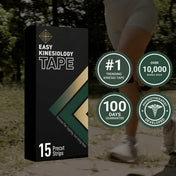
Kinesiology tape is the elastic cotton strip this company sells, and the guideline's word for it is "conditional." The exact line: "Kinesiotaping is conditionally recommended for patients with knee and/or first CMC joint OA" [1]. The guideline explains the appeal — "Kinesiotaping permits range of motion of the joint to which it is applied, in contrast to a brace, which maintains the joint in a fixed position" [1] — and Cleveland Clinic orthopedic specialist Dominic King, DO, adds the part a seller would rather skip: "there isn't enough high-quality evidence to make a strong recommendation, and there are experts who doubt its effectiveness" [4].
The strongest anti-tape evidence deserves its own sentence. A 2021 American Family Physician review of eleven randomized trials against sham taping concluded that "Kinesiology taping probably does not produce a clinically significant reduction in knee pain from osteoarthritis" [5]. We quote that in full in does kinesiology tape work for knee pain? and we're not going to soften it here.
So why is it on this list at all? Two reasons, both from the sources above. Dr. King: "The risk for harm is extremely low" [4]. And the guideline still grades it as something worth trying for the right person, which is more than it says for TENS or massage. In practice, tape is the option you wear while you do the strong-list things — a light, drug-free support that stays on for the walk, the tai chi class, the shower afterward — not a replacement for any of them. If that's the job you have in mind, how to tape a knee for arthritis shows the gentle version of the application.

What does the guideline recommend against?
Some popular "natural" options get a thumbs-down from the same guideline that grades the ones above, and the ranking pages never mention it. The ACR 2019 guideline states that "Transcutaneous electrical stimulation (TENS) is strongly recommended against in patients with knee and/or hip OA," because "Studies have demonstrated a lack of benefit for knee OA" [1]. Wedged shoe insoles are conditionally recommended against, and so is massage therapy for knee OA — the massage studies, per the guideline, have been small and at high risk of bias [1]. None of these will hurt you. The guideline's point is that your money and your hope are better spent higher up this page.
What about the drug-free options that aren't really drug-free?
One honest footnote. Every "natural remedies" list quietly skips the fact that the ACR's strongest-graded treatment after exercise and weight loss is a topical NSAID gel rubbed on the knee — "Topical NSAIDs are strongly recommended for patients with knee OA," and the guideline suggests they "should be considered prior to use of oral NSAIDs" [1]. It's a drug. It's also far less of a drug, systemically, than a pill, and if your goal is fewer pills rather than zero pharmacy products, it's a question worth asking your prescriber. This page doesn't recommend it; the guideline does.
What do verified buyers with arthritic knees say about the tape option?
The reviews below are verbatim, from verified purchases, and they're the reason this page can say anything beyond what the guideline says. They are individual experiences. Results may vary applies to every one of them, and the first one especially is one person's report, not what most people should expect.
"I have an IT injury along with arthritis in both knees… I order these strips in a moment of desperation… I can not begin to explain the relief!! I'm walking like I was 50." — Susan Smith, verified review (Results may vary.)
"These tapes have eased my pain and allow me to walk comfortably for a longer period of time!" — Linda Carman, verified review (Results may vary.)
"The tape was easy to apply and lasted three days on my knee. It was also easy to take off. I felt that it helped to alleviate the OA pain in my knee." — Diana Noad, verified review (Results may vary.)
"This is my second time ordering. I've been using the tape on my knee for several months. It definitely makes a difference." — Sharon Wilson, verified review (Results may vary.)
And the ones a seller doesn't usually print:
"this tape did not work for me… and the fact that it's hard to apply maybe the bigger issue." — Andrew Ricks Jr, verified review
"Tape does not stick to the skin well at all. Within 30 mins the ends start to roll up." — Teffney Shearer, verified review
That spread matches the evidence. Some arthritic knees feel supported and some don't, and the guideline's "conditional" is the right word for exactly that.
How should you order these for your own knee?
Move first, unload second, support third. That's the whole synthesis of the two big sources on this page:
- Move first. Exercise and tai chi carry the strongest grade [1] and showed up near the top of every outcome in the 2025 head-to-head analysis [2]. Pick the form you'll repeat — a walk, a pool, a class.
- Unload second. If you're carrying extra weight, every pound off is about four pounds off the knee per step [3]. A cane in the opposite hand unloads the joint today [1].
- Support third. A fitted brace for the right type of arthritis has the best numbers in the newest study [2]; kinesiology tape is the lighter, conditional option you can wear through all of the above [1][4].
- Skip the TENS unit and the wedge insoles, per the guideline [1].
- Take the list to your prescriber before changing any medication. That isn't a disclaimer — it's the guideline's own instruction [1].
If tape is the support you want to try, ours is pre-cut, latex-free, and comes with a 100-Day Money-Back Guarantee — and the arthritis buying checklist tells you what to look for in any brand, ours included. The full knee-pain guide covers everything else. If a doctor has used the phrase "bone on bone" about your knee, what bone on bone really means explains the label before you weigh the options.
References
- Kolasinski SL, Neogi T, Hochberg MC, et al. 2019 American College of Rheumatology/Arthritis Foundation Guideline for the Management of Osteoarthritis of the Hand, Hip, and Knee. Arthritis Care & Research. 2020;72(2):149–162. rheumatology.org/osteoarthritis-guideline
- Chen X, Fan Y, Tu H, Luo Y. Clinical efficacy of different therapeutic options for knee osteoarthritis: A network meta-analysis based on randomized clinical trials. PLOS One. 2025. journals.plos.org
- Messier SP, Gutekunst DJ, Davis C, DeVita P. Weight loss reduces knee-joint loads in overweight and obese older adults with knee osteoarthritis. Arthritis & Rheumatism. 2005. pubmed.ncbi.nlm.nih.gov/15986358
- King D. Can Kinesio Tape Help With Osteoarthritis? Cleveland Clinic Health Essentials. 2021. health.clevelandclinic.org
- Kelley C, Kelsberg G, Safranek S. Kinesiology Taping for Knee Osteoarthritis Pain. American Family Physician. 2021;103(7):434–436. aafp.org
Medical disclaimer: This article reports published clinical guidelines and research for general information. It is not medical advice, it doesn't cure or treat any condition, and it is not a reason to start or stop any medication. Kinesiology tape is a drug-free support product; results vary from person to person. Talk with your doctor, physical therapist, or rheumatologist about what's right for your knee — especially before changing a prescribed treatment.