
Latex-Free and Sensitive-Skin Kinesiology Tape: What Clinics and Retailers Should Verify
Disclosure first: I co-founded Easy Kinesiology and we sell pre-cut kinesiology tape, including a sensitive-skin version, to clinics and stores. Our own box says "latex-free" and "hypoallergenic," the two phrases this page takes apart. I'm not a dermatologist or an allergist. Every source below is linked and quoted word for word, and none of this is advice about any one patient's skin.
"Latex-free" and "hypoallergenic" are the two phrases on nearly every kinesiology tape box, ours included, and neither one tells a buyer as much as it sounds. FDA's guidance on medical product labeling calls "latex-free" not accurate and recommends a narrower statement instead [1]. "Hypoallergenic" isn't a test result at all: the Hospital for Special Surgery notes that tape "is supposed to be hypoallergenic, but between 5% and 15% of users are allergic to the material" [2].
So a Texas clinic stocking a treatment room, or a pharmacy or running store deciding which tape to shelve, can't buy on the label. What a buyer can do is ask better questions. This page covers what each phrase does and doesn't promise, what the clinicians in the largest US taping survey already tell patients about skin, and seven questions worth putting to any supplier, us included.
What does "latex-free" on a tape box actually tell you?
Less than it seems. In its 2014 final guidance on labeling medical products, FDA wrote that statements "such as 'latex-free,' 'does not contain natural rubber latex,' or 'does not contain latex' are not accurate because it is not possible to reliably assure that there is an absence of the allergens associated with hypersensitivity reactions to natural rubber latex" [1]. It added that these terms "may give users allergic to natural rubber latex a false sense of security" [1].
FDA's recommended wording is narrower and more useful: "Not made with natural rubber latex." Used without qualification, FDA says, that statement "would apply to the medical product, its container, and any packaging" [1]. That's the useful part for a buyer. It turns a vague label into three yes-or-no questions: was natural rubber latex used in the tape, in the release liner, or in the packaging?
We'll be plain about our own label. Our product page says "100% latex-free," the same phrase as most of the category. The more precise thing we can tell you is what the tape is made of: 95% cotton and 5% elastane, with a Japanese-sourced acrylic adhesive [6]. If a supplier can't answer the three-part latex question in writing, that tells you something too.
Does "hypoallergenic" mean nobody will react?
No. The word isn't tied to a test result a buyer can check on the box, and reactions happen with tapes sold as hypoallergenic. HSS puts it at 5 to 15% of users allergic to the material [2]. The same page warns that tape "may create blisters and skin damage, so it should not be put on open wounds or used on people who have very frail skin, like older patients" [2].
The brands know this. KT Tape's sensitive-skin page calls its products "Hypoallergenic, Latex-Free, Natural Rubber-Free!" and on the same page recommends "testing a small piece of KT Tape applied with no stretch on tougher skin such as the knee or forearm" [4]. Kinesio's sensitive-skin roll is sold as "a comfortable latex-free, and hypoallergenic tape for those who have skin sensitivities" [5]. Our own product page makes the same claims and carries the same kind of caveat: "No adhesive suits every skin" [6]. A label that needs a patch-test footnote is a screening claim. Treat it as one.
How do the published patch-test instructions compare?
They agree on the idea and differ on the details. Here are three, quoted from the source.
| Source | Where | How long | Stop rule |
|---|---|---|---|
| Hospital for Special Surgery [2] | "on the forearm" | "wait at least one hour for a reaction" | "If you feel itchy under or around the skin covered by the tape, remove the tape right away and do not use it." |
| KT Tape [4] | "tougher skin such as the knee or forearm," "with no stretch" | Not given in the quoted instruction | Not given in the quoted instruction |
| Easy Tape [6] | "a small piece to your forearm" | "leave it for an hour" | "remove any tape that itches" |
For a clinic, the difference matters less than whether anyone runs the test at all. For a store, it's worth checking that the box or a shelf card says it somewhere a shopper will read before buying.
What do clinicians already tell patients about skin?
Most give instructions; a large minority don't. In the 2021 survey of 1,083 US physical therapists, athletic trainers and chiropractors, "Most respondents provided skin prep (64%) and tape removal (77%) instructions. Some did not provide any skin prep (36%) or tape removal (23%) instruction" [3]. The common prep instructions were to "clean and dry skin (53%)," "avoid lotions, oils, topicals, or gels (37%)," and "trim or remove hair on the body region (12%)" [3].
Skin is already on clinicians' radar. Half of respondents (51%) "considered skin irritation and itching as precautions," and a third (33%) listed skin allergies, adhesives and latex among them, as contraindications [3]. The gap is the handout. A clinic choosing a sensitive-skin tape gets more from a one-page prep and removal sheet than from any label claim, because 36% of surveyed clinicians weren't giving prep instructions at all [3].
What do buyers say about tape and their skin?
Consumer reviews of our tape show both sides of the trade. These are consumer reviews, not clinic data. Results may vary.
"I love this stuff!! Easy to use and my skin doesn't itch." (pamela stith, verified consumer review)
One buyer asked the question every store should be ready for:
"my body felt funny once applied. Is there side effects? I didn't see any ingredients or warning labels?" (Robert Zuniga, verified consumer review)
That review is the reason materials and a skin warning belong where a shopper can see them. And gentler isn't free. The usual trade with a lower-tack adhesive is hold, and adhesion complaints come in even now. One buyer of our tape wrote:
"Tape does not stick to the skin well at all. Within 30 mins the ends start to roll up." (Teffney Shearer, verified consumer review)
For a stocking decision, that means a sensitive-skin version should sit beside the standard one, not replace it. Skin prep and wear time are covered in detail on our consumer pages about kinesiology tape for sensitive skin and how long the tape stays on.
What should a buyer ask a tape supplier?

Seven questions. Each one has a written answer a good supplier can give you, and each comes from a source above.
- Was natural rubber latex used in the tape, the liner, or the packaging? FDA's wording covers all three [1]. Get it in writing.
- What is the adhesive? "Acrylic" is a real answer; "medical-grade" alone isn't. Ours is a Japanese-sourced acrylic [6].
- Is there a sensitive-skin version, and what changes in it? Ask whether it's the same size and shape, so staff and patients don't relearn the application. Ours is the same shape and size with a lower-tack adhesive, at the same price as the original [6].
- Is the wear rating split by version? A gentler adhesive may hold for less time; KT Tape rates its gentle line at 1 to 3 days [4]. Our page gives one 2 to 7 day rating for both versions [6], and our buyers most often report 2 to 3 days.
- What patch-test wording is printed on the box or page? Compare it with the HSS instruction [2].
- Do you supply skin-prep and removal instructions a clinic can hand out? That's the 36% and 23% gap in the clinician survey [3].
- What happens if a patient or customer reacts? Know the return terms before you stock. For a single box bought on our consumer page, that's the 100-Day Money-Back Guarantee; there's no published clinic or reseller policy yet.
None of these answers makes a tape safe for any one person. They make the label checkable.
Where Easy Tape fits
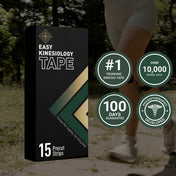
Easy Kinesiology has B2B operations in Texas. Our tape comes as pre-cut strips, 15 per box, in two versions: Original and Sensitive Skin, same shape and size, the second with a lower-tack adhesive for skin that reacts to stronger tapes [6]. The fabric is 95% cotton and 5% elastane; the adhesive is a Japanese-sourced acrylic. There's no published clinic price list yet. For the per-application math a clinic should run before any order, see our cost-per-application worksheet. Volume inquiries go through our contact page, and a single box of either version can be tried from the consumer page under the 100-Day Money-Back Guarantee.
Quick answers
Does latex-free mean a tape can't cause a latex reaction? Not by itself. FDA's 2014 guidance calls "latex-free" not accurate for medical product labeling, because absence of the allergens "is not possible to reliably assure," and recommends "Not made with natural rubber latex" instead [1].
Is hypoallergenic kinesiology tape safe for sensitive skin? No label can promise that. HSS notes that tape "is supposed to be hypoallergenic, but between 5% and 15% of users are allergic to the material," and recommends a forearm test of at least one hour [2].
What adhesive does kinesiology tape use? It varies by brand, so ask the supplier to name it in writing. Ours is a Japanese-sourced acrylic [6].
Should a clinic stock a sensitive-skin version? If you tape patients with reactive or fragile skin, it's worth having beside the standard tape, as long as it's the same size and shape and you know its wear rating. HSS advises against taping open wounds or very frail skin at all [2].
What skin instructions should patients get? The common ones in the 2021 clinician survey were to clean and dry the skin, avoid lotions and oils, and trim hair, plus removal instructions; 36% of respondents gave no skin-prep instruction [3].
Medical disclaimer: This article explains labeling language and quotes published sources for general information. It is not medical advice and does not assess whether any tape is suitable for a particular person. Anyone with a known latex or adhesive allergy, broken skin or a skin condition should ask a clinician before using kinesiology tape. Kinesiology tape supports comfort and mobility; it does not diagnose, treat or cure any condition. Individual results may vary.
References
- U.S. Food and Drug Administration. Recommendations for Labeling Medical Products to Inform Users that the Product or Product Container is not Made with Natural Rubber Latex. Final guidance, December 2, 2014. https://www.fda.gov/regulatory-information/search-fda-guidance-documents/recommendations-labeling-medical-products-inform-users-product-or-product-container-not-made-natural
- Hospital for Special Surgery. Kinesiology Tape: What It Is and How to Use It. https://www.hss.edu/health-library/move-better/kinesiology-tape
- Cheatham SW, Baker RT, Abdenour TE. Kinesiology Tape: A Descriptive Survey of Healthcare Professionals in the United States. International Journal of Sports Physical Therapy, 2021;16(3). https://pmc.ncbi.nlm.nih.gov/articles/PMC8169012/
- KT Tape. KT Tape Gentle (product page, as published October 16, 2026). https://www.kttape.com/products/kt-tape-gentle-tape-1
- Performance Health. Kinesio Tex Gold Light Touch+ (product page, as published October 16, 2026). https://www.performancehealth.ca/kinesio-tex-gold-light-touch
- Easy Kinesiology. Kinesiology tape product page, specifications (brand-authored). https://easykinesiology.com/pages/kinesiology-tape