
How Long Does Kinesiology Tape Stay On? What Real Wear Reports Say
Written by Brian Li, Co-Founder, Easy Kinesiology
Last updated: July 24, 2026
I co-founded Easy Kinesiology, so I sell the product this article discusses — that bias is disclosed up front. What follows leans on published guidance from physical therapy sources and on verbatim wear reports from our verified buyers, including the unflattering ones.
Kinesiology tape stays on for 3 to 5 days in most published guidance, and manufacturers rate premium tapes for up to 7. On a knee, plan for less: the verified buyers who report wear times in our reviews most often get 2 to 3 full days, through showers, sweat, and sleep.
That gap between the box and the knee is what this page is about. Most articles on tape wear time repeat a manufacturer range and stop. We compared the published ranges against what real buyers report on real knees — including the applications that failed inside half an hour — because if you're deciding whether tape beats a brace or a sleeve for daily wear, the honest number matters more than the optimistic one.
What do the published wear-time ranges say?
Published wear times disagree more than you'd expect, and the disagreement is worth seeing in one place:
| Source | Stated wear time |
|---|---|
| Hospital for Special Surgery (HSS) | "Several days and up to three weeks" [1] |
| Thysol / CureTape (manufacturer) | "On average, a tape will last for 4 to 6 days" [2] |
| Medpoint (medical supplier) | 3 to 5 days; knees and legs up to 5 days [3] |
| Easy Tape (our own rating) | 2 to 7 days |
| Easy Tape verified reviewers | Most often 2 to 3 days on a knee |
Why the spread? Three reasons, none of them sinister. First, tape type: elastic cotton kinesiology tape and rigid athletic tape wear completely differently, and some clinical sources fold both into one number. Second, body part: tape on a flat, low-movement area like the mid-back outlasts tape on a joint that folds thousands of times a day. Medpoint's per-area breakdown makes this explicit — ankles and feet get 1 to 3 days while legs get up to 5 [3]. Third, who's counting: a manufacturer's rating describes good conditions and correct application, while a buyer's review describes a Tuesday.
The knee is the hard case. It bends with every step and stair, it lives under trousers that rub against the tape edges all day, and it sweats. So a knee sits at the short end of every published range — which is exactly what our buyers report.
How long does kinesiology tape stay on a knee, according to real users?
The most useful wear data we have is also the simplest: verified buyers saying how long the tape stayed on. Two of the clearest, verbatim:
"Lasts two days through all movement and is the best I have found. I have tried many brands and this one lives up to its claims." — Laurie Juskiewicz, verified review (Results may vary.)
"The tape was easy to apply and lasted three days on my knee. It was also easy to take off." — Diana Noad, verified review (Results may vary.)
Two to three days, through full movement — that's the honest center of the distribution for a knee, and it's why we tell buyers to treat our own "up to 7 days" rating as a ceiling for ideal conditions, not a promise. Water, on its own, isn't what ends a wear cycle. As one reviewer put it: "it stays on in water and when it's hot outside and your knees sweat" — Paige Harvey, verified review (Results may vary.)
And here is the part most wear-time guides leave out: sometimes tape fails fast. Also verbatim, also from our own verified reviews:
"Tape does not stick to the skin well at all. Within 30 mins the ends start to roll up." — Teffney Shearer, verified review
"within an hour under my slacks they have rolled up in a ball" — Kathy Harvey, verified review
A 30-minute failure and a 3-day success are usually the same tape on different skin prep — and occasionally the same tape on different skin chemistry, which no brand fully controls. The difference is almost always one of the causes below.
What makes kinesiology tape fall off early?
Kinesiology tape adhesive is heat-activated and pressure-bonded, which means most early failures trace back to the first five minutes of application. The usual suspects, in rough order of likelihood:
- Lotion or skin oil. TapeGeeks calls lotion and skin oil "the #1 cause of premature tape peeling" [4], and our review complaints agree. Adhesive can't grip through a film of moisturizer — wash the knee with soap or rubbing alcohol and dry it completely first.
- Stretched ends. The last two inches at each end of a strip must go on with zero stretch. A stretched end recoils like a rubber band and lifts within hours [4].
- Square or hand-cut corners. Sharp corners catch on clothing and start the peel [4]. Kathy Harvey's slacks did exactly this. Round the corners on roll tape, or use pre-cut strips with no corners to cut.
- Skipping the rub. The adhesive bonds with friction and body heat, and Thysol's guidance is that full adhesion takes about 30 minutes to develop [2]. Rub the applied strip briskly for ten seconds, then give it time before a long walk.
- Skin that fights adhesive. Oily skin, dense hair, and humidity all shorten wear [2][3]. Trim heavy hair with clippers — don't shave right before taping — and expect shorter wear in hot weather.
None of this requires athletic skill. It requires dry skin, loose ends, and patience for one ten-second rub.
How do you make kinesiology tape stay on longer?
Five habits reliably move a knee application from the 30-minute failure group into the multi-day group:
- Wash and fully dry the knee first — no lotion, no leftover soap film, no damp skin.
- Apply with the knee bent to about 90 degrees, so the strip carries slack and doesn't fight the joint on your first stair.
- Lay both ends down with zero stretch, whatever tension you use in the middle.
- Rub the whole strip for ten seconds, then wait 30 minutes or more before exercise or long walking [2].
- After a shower, pat the tape dry with a towel — rubbing it lifts the edges, and long soaks in a bath or hot tub soften adhesive faster than showers do.
If an edge lifts mid-wear anyway, trim the lifted piece off with scissors instead of pressing it back down. Peeled adhesive collects lint and won't re-bond, but a trimmed strip keeps working.
Can you shower, swim, and sleep in kinesiology tape?
Yes to all three — cotton kinesiology tape is designed to be worn around the clock, and water exposure by itself doesn't end a wear cycle. Thysol states its tape is designed so "showering, swimming and bathing can continue as normal," with a towel-dry afterward [2]. Our buyers confirm the same on knees: "Easy to apply and stays on even thru showers!" — Anita Lungari, verified review (Results may vary.)

Sleep is where multi-day wear pays off. Tape that stays on overnight is still supporting the knee when you take the first steps of the morning — a moment plenty of our arthritis-age buyers name as the hardest of the day. The complete knee-pain guide covers what that support can and can't do.
When should you take kinesiology tape off?
Take kinesiology tape off when the ends have rolled, when the stretch feels dead, or when the skin underneath itches, burns, or looks red — whichever comes first. A strip past its grip isn't supporting anything; it's decoration. And skin reactions, while uncommon, are real: HSS notes that between 5% and 15% of users experience allergic reactions to tape material [1]. Any itching or rash means the tape comes off now and that skin gets a rest before you tape again. Our own strips use a latex-free, hypoallergenic adhesive for exactly this reason, and a sensitive-skin version exists — but no adhesive suits every skin. The sensitive-skin guide covers the patch test and how to tell irritation from a true allergy.
Removal technique matters as much as timing, especially on thinner, older skin. John Castro, PT, DPT, a clinical supervisor at HSS with nearly 30 years of taping experience, puts it this way: "To remove the tape with minimal skin irritation, I recommend patients soak it when bathing, apply some oil on the area, hold the skin and pull the tape off slowly and gently." [1] Slow, low, and oiled — never a fast rip. The step-by-step application guide walks through removal in more detail.
Between applications, look at the skin. If it's pink, irritated, or peeling, give it a day off before the next strip. Multi-day wear only works on skin that gets to recover between rounds.
Where does Easy Tape land on wear time?
Full disclosure again: this is our product, so weigh this section accordingly.

Easy Tape kinesiology tape is rated for 2 to 7 days of wear through showers, sweat, and sleep — and as this whole page has argued, the number to plan around on a knee is the 2-to-3-day figure our verified reviewers most often report, not the ceiling. We'd rather you buy the tape expecting Tuesday-to-Thursday and be pleasantly surprised than expect a week and feel shortchanged.
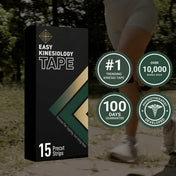
Two design choices bear directly on the wear-time problem. The strips come pre-cut in a patented diamond shape, so there are no hand-cut square corners to snag on clothing and no scissors work to get wrong — that whole failure cause drops off the list. And the adhesive is latex-free and anti-rash by design, built for the older skin most of our buyers live in. Verified buyers rate the tape 4.7 stars on average, and every order carries a 100-Day Money-Back Guarantee — if it won't stay on your knees, that's covered: see the tape here.
If you're comparing options first, start with the best kinesiology tape for arthritis knees checklist, or the seniors' guide if fiddly application is the bigger worry. And once a strip is on, the video tutorials show 9 knee-specific applications demonstrated on camera.
References
- Hospital for Special Surgery — "Kinesiology Tape: What It Is and How to Use It" (expert: John Castro, PT, DPT, OCS, MTC) — https://www.hss.edu/health-library/move-better/kinesiology-tape
- Thysol USA — "Kinesiology tape — Frequently Asked Questions" — https://www.thysol.us/kinesiology-tape-instructions/faq/
- Medpoint — "How Long to Leave Kinesio Tape On: A Complete Guide" — https://medpoint.ie/how-long-to-leave-kinesio-tape-on/
- TapeGeeks — "8 Kinesiology Tape Mistakes That Kill Results" — https://tapegeeks.com/blogs/news/8-tips-for-applying-kinesiology-tape-find-answers-to-commonly-asked-questions
Medical disclaimer
This content is for informational purposes only and is not medical advice. The information provided should not be used to diagnose or treat any health problem or disease. Always consult a qualified healthcare professional before changing your treatment plan or exercise routine. Individual results may vary. Easy Tape is not intended to diagnose, treat, cure, or prevent any disease.