
Is Kinesiology Tape Safe for Sensitive Skin? An Honest Answer From a Tape Company
Written by Brian Li, Co-Founder, Easy Kinesiology
Last updated: August 22, 2026
I co-founded Easy Kinesiology, and we sell kinesiology tape — including a version made for sensitive skin. So I have a financial interest in you deciding taping is safe for you. Keep that in mind while you read, and check everything against the sources linked at the bottom. What I can offer that the other pages on this topic don't: the real reports from our own verified buyers, including the uncomfortable ones.
Kinesiology tape is an elastic cotton strip with an adhesive backing that's worn on the skin for days at a time — and for most people, including most people with reactive skin, it's well tolerated. But "most" is doing work in that sentence. The Hospital for Special Surgery (HSS) puts it bluntly: "The tape is supposed to be hypoallergenic, but between 5% and 15% of users are allergic to the material" [1]. Meanwhile the dermatology literature finds that true tape allergy is rare — reported by 0.3% of patients — and that most reactions are something else entirely [2].
Those two numbers sound like they disagree. They mostly don't, and the gap between them is the useful part: the majority of tape reactions are irritation, not allergy. Irritation comes from how the tape is worn and removed, which means you can do something about it. This page walks through the difference, the one-hour test that settles the question for your own skin, and what to check on any label — ours included.
What causes skin reactions to kinesiology tape?
Almost never the fabric. The strip itself is usually cotton or a cotton blend; the trouble lives in the adhesive and in how the tape pulls on skin.
Three separate things get lumped together as "tape rash":
- Adhesive irritation. The most common one. An adhesive grips the top layer of skin for days, and when the tape stretches or gets peeled off fast, that layer takes mechanical stress. A 2015 review in the journal Dermatitis found that most reactions to medical tapes are these nonallergic reactions, not true allergies [2].
- True adhesive allergy. Real, but rare — the same review reports tape allergy in 0.3% of patients [2]. If you're in that group, your skin reacts to the adhesive chemistry itself, not to how the tape was worn.
- Latex. Some tapes use latex-based adhesives. If you have a known latex allergy, the label is the first thing to check, before any patch test. (Easy Tape is 100% latex-free — more on that below.)
HSS's 5-to-15% figure [1] sits on top of all three categories at once, which is why it reads scarier than the 0.3% allergy number. Both are worth knowing. One says reactions happen often enough to take seriously. The other says the cause is usually fixable — technique and wear time, not your immune system.
Is it an allergy or irritation — and how can you tell?
The 2015 Dermatitis review's authors put it this way: true tape allergy and nonallergic reactions "are mechanistically distinct and can be distinguished from each other based on history" [2]. In plain terms — the pattern tells the story, and a dermatologist can read it. Some general patterns worth knowing about, purely as background:
| Sign | Points toward |
|---|---|
| Itching that starts under the tape while it's on | Reaction — remove the tape (see below) |
| Redness only where edges pulled or tape was stretched | Irritation from mechanical stress |
| Rash spreading beyond the taped area, or worsening each use | Something to show a professional |
| Brief pinkness after peeling that fades within the hour | Common and usually meaningless |
Don't self-diagnose past this table. If your skin reacts repeatedly, or a rash spreads or sticks around, that's a dermatologist's question, not a tape company's. What everyone agrees on is the first move: HSS's advice is that "if you feel itchy under or around the skin covered by the tape, remove the tape right away and do not use it" [1]. No waiting it out, no "maybe it settles."
How do you test a tape before trusting it?
With a patch test — and it's less of a project than it sounds. HSS: "A good way to know if you are allergic is to apply a piece of the tape on the forearm and wait at least one hour for a reaction" [1].
So before the first real application on a knee:
- Cut or use a small piece of the tape — a corner of one strip is plenty.
- Stick it on the inside of your forearm, where skin is thin and reactive.
- Leave it at least an hour. Cautious skin can leave it longer — the test costs nothing but time.
- Peel it off slowly and look. Itching, burning, raised bumps, or spreading redness — that tape isn't for you. A faint pink outline that fades — normal.
One strip sacrificed to the forearm beats a full application you have to tear off an angry knee two hours later. If a brand's tape fails your patch test, that's real information about that adhesive and your skin — a different adhesive may still pass.
What should sensitive skin look for on the label?
Four things, in order of importance:
- Latex-free. Non-negotiable if you have a latex allergy, and a reasonable default for reactive skin generally. If the listing doesn't say, ask the seller — silence on latex is its own answer.
- The adhesive's track record. "Hypoallergenic" on the box is a starting claim, not a guarantee — HSS's 5-to-15% figure [1] is about tapes that carry exactly that word. What you want is evidence this specific adhesive behaves: a gentler-formula version, buyer reports from people with skin like yours, a guarantee that makes testing free.
- Breathable fabric. Cotton or a high-cotton blend lets sweat evaporate instead of sitting under the strip for days.
- A wear rating you'll respect. Every extra day on the skin is extra days of adhesive contact. If a tape is rated for multi-day wear, that's convenient — and it also means you should take the removal instructions seriously rather than yanking.
Who should ask a clinician before taping at all?
A tape company telling you when not to buy tape is odd, but here it is. HSS is direct about this: "The tape may create blisters and skin damage, so it should not be put on open wounds or used on people who have very frail skin, like older patients" [1]. Much of our audience is older — that caution belongs in this post, not buried in a footnote.
Ask a professional first if any of these apply:
- Your skin has become thin, papery, or easily bruised — common with age and with some medications.
- You'd be taping over broken skin, a healing wound, a rash that's already there, or recently shaved skin that's irritated.
- You have a diagnosed skin condition and your dermatologist hasn't weighed in on adhesives.
- Previous tapes or bandages have repeatedly left you with reactions.
None of this means taping is off the table for older skin — plenty of our buyers are retirees, and you'll hear from some below. It means the patch test matters more for you, not less, and a clinician who knows your skin beats any blog post, including this one.
How do you remove tape without wrecking your skin?
Removal is where careful skin gets undone. The urge is to rip — wet tape after a shower, one fast pull. That's the mechanical stress that causes the most common category of reaction [2].
The gentler protocol, per HSS: "soak it when bathing, apply some oil on the area, hold the skin and pull the tape off slowly and gently" [1]. In practice: end the wear cycle after a shower, work a little baby oil or olive oil under the edges, press your free hand flat against the skin next to the strip, and peel the tape back low and slow — folded back over itself, not lifted straight up. Skin stays anchored, adhesive lets go, nobody's the wiser.
Our own wear guidance is 2 to 7 days, and our buyers most often report 2 to 3 days of hold — the full wear-and-removal picture is in how long kinesiology tape stays on.
What do buyers with reactive skin report about Easy Tape?

Here's the part no other page ranking for this search will give you: real reports, from verified purchases, including the ones that don't flatter us.
The quote a sensitive-skin buyer is looking for exists in our review bank: "I love this stuff!! Easy to use and my skin doesn't itch." — pamela stith, verified review. (Results may vary.) That's one buyer's skin, not a promise about yours — the patch test above is still the only way to know your own answer.
And the less comfortable ones. One verified buyer, Robert Zuniga, wrote: "my body felt funny once applied. Is there side effects? I didn't see any ingredients or warning labels?" That's a fair question and it deserved a public answer, so: the strip is 95% breathable cotton and 5% elastane, the adhesive is our proprietary anti-rash formula, and the whole product is 100% latex-free and drug-free — it works mechanically, by supporting the area, with nothing medicated in it. If anything ever feels wrong under the tape, HSS's rule is ours too: take it off right away [1].
Adhesion has its own honest spread. Anita Lungari reports her strips are "easy to apply and stays on even thru showers!" — while Teffney Shearer reported the opposite: "Tape does not stick to the skin well at all. Within 30 mins the ends start to roll up." Both are verified buyers. Skin chemistry, prep, and oils differ, and an adhesive mild enough to be kind to skin will lose the grip battle on some of it. Any brand telling you its tape works on everyone is describing tape that doesn't exist.
Where Easy Tape fits
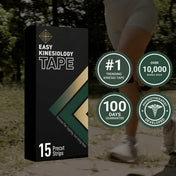
The plain facts, so you can judge the fit yourself: Easy Tape strips are pre-cut in a patented diamond shape — no scissors, no measuring, which also matters for applying tape when your hands are stiff — with a proprietary anti-rash adhesive on 95% breathable cotton, 100% latex-free and hypoallergenic, designed by a physiotherapist, and rated for 2 to 7 days of wear. Across verified purchase reviews our average is 4.7 stars, and the complaints you read above are part of that record.
Two things specifically for the reactive-skin reader. First, we make a dedicated Sensitive Skin version of the tape — same shape, gentler formulation — because "one adhesive for everyone" stopped being an honest position once enough skin disagreed with it. Second, the 100-Day Money-Back Guarantee turns the patch test into a free experiment: if your forearm says no, your money comes back.
And if your skin says no to every tape it meets — believe it. A knee that needs support has other options, and your dermatologist beats our checkout page. The broader picture of what tape can and can't do for a knee is in our complete guide to kinesiology tape for knee pain.
Quick answers
Is kinesiology tape safe for sensitive skin? Usually, with precautions. Most reactions to tape are irritation from the adhesive, wear time, or fast removal — not true allergy, which the dermatology literature reports in a small minority of patients [2]. Patch test on the forearm first [1], choose latex-free tape, and remove anything that itches immediately.
How common are reactions to kinesiology tape? HSS reports that 5 to 15% of users are allergic to the material despite hypoallergenic labeling [1], while a dermatology review found true tape allergy reported by 0.3% of patients, with most reactions being nonallergic [2]. Read together: reactions aren't rare, but the usual cause is mechanical irritation you can reduce, not allergy.
How long should the patch test last? HSS advises applying a piece to the forearm and waiting at least one hour [1]. Longer is more informative if your skin has a history of slow reactions. Any itching, burning, or spreading redness during the test means that tape isn't for your skin.
Does Easy Tape contain latex? No — Easy Tape is 100% latex-free, with a proprietary anti-rash adhesive on 95% cotton, and a dedicated Sensitive Skin version exists for skin that needs a gentler formula. Patch test anyway; no adhesive suits every skin, and our own reviews include both "my skin doesn't itch" and buyers whose skin disagreed.
What do I do if a rash appears under the tape? Remove the tape right away — HSS's guidance is not to keep using it if itching starts [1]. Let the skin recover, and if the rash spreads, worsens, or returns on the next careful use, show it to a dermatologist rather than experimenting further.
This article is for general information and isn't medical advice. Kinesiology tape offers comfort and support; it doesn't cure or treat any condition. If your skin reacts, if you're managing a skin condition, or if your knee is swollen or unstable, see a qualified professional. Individual results vary.
References
- Hospital for Special Surgery — Kinesiology Tape
- Smith SM, Zirwas MJ — Nonallergic Reactions to Medical Tapes, Dermatitis, 2015;26(1):38–43