
Pre-Cut vs. Roll Kinesiology Tape: Which Should You Buy?
Written by Brian Li, Co-Founder, Easy Kinesiology
Last updated: August 10, 2026
I co-founded Easy Kinesiology, and we sell pre-cut tape — so I have a side here, and you should know it before you read a word. It's the same story across this whole search result: the strongest page arguing for rolls is written by a roll company, and the pages praising pre-cut sell pre-cut. Everyone comparing these formats is selling one of them. What we can do is show both sides honestly, including the complaints our own buyers file about our own format.
Roll kinesiology tape is a continuous strip — usually five meters of it — that you measure, cut, and shape yourself. Pre-cut tape comes as finished strips: open the box, peel, apply. The tape itself does the same job either way; what changes is everything between the box and your knee — scissors, edges, time, and above all your hands. That's the honest one-line answer: the roll rewards skilled hands and punishes clumsy ones, and pre-cut charges you a little more to take the scissors out of the equation.
Which one you should buy comes down to a short test near the end of this page. Before that, both formats get their fair hearing — including the step that neither one makes easy, which no other page selling either format will tell you about.
What's the actual difference between pre-cut and roll tape?
Less than the packaging suggests, and more than the price tag shows. Meglio — a company that sells rolls and, by its own disclosure, makes no pre-cut product — puts the material question plainly in its buyer's guide: "The two formats use the same cotton-and-acrylic tape. The choice is about workflow and cost, not clinical effect" [2]. That's broadly right as a rule of the category, and it's worth hearing from the roll side. (Exact recipes do vary brand to brand — ours is a 95% cotton, 5% elastane weave with a latex-free adhesive — but the point stands: format is about handling, not a different kind of tape.)
Handling, though, is not a small thing. A roll hands you decisions: how long to cut, what shape to cut, whether to round the corners so they don't snag on clothing and peel early. Machine-cut strips arrive with those decisions made — every strip identical, every edge sealed and rounded from the factory. Hand-cut edges are where fraying starts; a strip that begins lifting at a ragged corner rarely finishes its second day. That edge difference, not the fabric, is the real physical distinction between the formats.
Everything else is arithmetic. A roll costs less per application and can become any shape you can cut. A box of pre-cut strips costs more per application and can only ever be the shape in the box.
Pre-cut vs. roll, side by side
| Roll tape | Pre-cut strips | |
|---|---|---|
| Cost per application | Lower — one roll yields many strips | Higher — you pay for the finishing |
| Scissors required | Yes, every application | No |
| Edges | Hand-cut; fray unless you round the corners | Machine-finished, sealed, rounded |
| Shapes and lengths | Anything you can cut | Fixed — what's in the box |
| Consistency | Depends on your hands that day | Identical every time |
| Skill needed | Real — measuring, cutting, shaping | Placement only |
| Best-known users | Clinicians and experienced tapers | First-timers, self-tapers, stiff hands |
Two rows decide most purchases. Cost, if you tape often and your hands are up to the work. And scissors, if they aren't.
When is the roll the better buy?
Three honest cases, from a company that doesn't sell one.
When cost per application matters most. A roll is cheaper per strip, full stop, and no pre-cut maker can argue otherwise — the finishing work is what you're paying us for. If you tape daily, that difference compounds. The roll companies make this point correctly, and we won't pretend it away.
When you need shapes and lengths a box doesn't hold. Longer runs for a thigh or back, Y-cuts and fan-cuts for specific techniques, narrow strips for small joints. A roll becomes whatever your scissors say. That flexibility is why professionals mostly work from rolls — Meglio's guide reports a US survey in which most clinicians reached for uncut rolls rather than pre-cut strips [2]. Experienced hands don't need the decisions made for them, and a clinic goes through enough tape for the economics to win on their own.
When you already cut and tape well. If you tape well — clean cuts, rounded corners, right stretch — the roll gives you control pre-cut can't, at a price pre-cut won't match. At that point the box is paying for help you no longer need.
The roll's costs are real too, and they land somewhere specific: your hands. Every application starts with measuring, cutting, and corner-rounding — done well, or paid for later when a square-cut corner starts peeling on day one.
When do pre-cut strips make more sense?
When scissors are the obstacle. This is the case the entire ranking set for this comparison skips, and it's the biggest one we see. The buyers we hear from most aren't athletes with a gym bag — they're people with aching knees and, often, hands that ache too. For arthritic or stiff fingers, taping is a two-joint problem: the knee the tape goes on, and the hands that have to cut and place it. Handing those fingers a roll of tape and a pair of scissors adds a task exactly where the difficulty already lives. Pre-cut removes it. We wrote a whole guide on applying knee tape when your hands are the hard part, because nobody else had.
When you want the same result every time. A strip cut by a machine is identical on your best day and your worst one. For self-taping — reaching around your own knee, no second pair of hands — repeatability matters more than customization. Here's what that sounds like from verified buyers rather than from us: "The tape was easy to apply and lasted three days on my knee. It was also easy to take off." — Diana Noad, verified review. "Easy to apply and stays on even thru showers!" — Anita Lungari, verified review. "Easy to use and my skin doesn't itch." — pamela stith, verified review.
When edge failure has burned you before. Sealed, rounded, machine-finished edges are the pre-cut format's quiet advantage: the corner that would have frayed was never cut by hand in the first place. Wear time still varies by skin and activity — the category's own reference range runs from "several days and up to three weeks," per the Hospital for Special Surgery [1]; our strips are rated for 2 to 7 days and our buyers most often report 2 to 3. One of them, a serial brand-switcher: "Lasts two days through all movement and is the best I have found. I have tried many brands and this one lives up to its claims." — Laurie Juskiewicz, verified review. The day-by-day breakdown of what real knees get is on the wear-time page.
The step neither format fixes — and no seller mentions
Here's the part you won't find on any other page in this comparison, because it's the kind of thing sellers don't print about their own product. Pre-cut removes the scissors. It does not remove the backing peel — separating the paper from the adhesive — and for stiff hands, that's the hardest step of the whole job.
Our own verified reviews say so, about our own pre-cut product: "it is very difficult to get the backing off to apply. I am a senior… I end up with more clumped up tape before I can get it placed." — Beverly Hall, verified review. "hard to take off the backing from the tape." — Lisa Ito, verified review. "Must be applied perfectly or it twists." — Eleanor Damico, verified review. And the bluntest one: "this tape did not work for me… and the fact that it's hard to apply maybe the bigger issue." — Andrew Ricks Jr, verified review.
We publish those because they're true, and because they set the honest boundary of this comparison: pre-cut makes taping easier, not effortless. Our strips are die-cut in a diamond pattern engineered to give stiff fingers a starting point on the backing, and the step-by-step application guide shows the seated, no-pinch routine that gets around most of the struggle. But if a roll's scissors work would defeat your hands, know that the peel takes some learning too — with either format.
The hands test
Forget user-type labels — athlete, senior, beginner. Answer three questions about your actual hands and week.
- Can your hands comfortably measure, cut, and round the corners of a strip — every time, including bad days? If yes and you tape often, buy the roll. It's cheaper per application and endlessly adaptable, and the skill is learnable. That's the honest recommendation from a company that doesn't sell one.
- Do your fingers protest at scissors, small motions, or gripping? Buy pre-cut, and expect the backing peel to take a few tries to master even so. Removing the cutting step is exactly the help stiff hands need; pretending the rest is effortless would be a lie.
- First time taping and not sure it's for you? Start pre-cut. Fewer variables means the test tells you about the tape, not about your scissor work. If it earns a place in your routine and your hands are game, a roll later is a fine upgrade.
And in every case: kinesiology tape of either format is a comfort-and-support tool, not a treatment. A knee that's swollen, unstable, or getting worse needs a clinician before it needs a format opinion.
Where Easy Tape fits

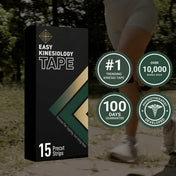
If the test landed you on pre-cut, here's ours in plain facts: strips die-cut in a patented diamond shape — no scissors, no measuring, edges finished at the factory; a latex-free, hypoallergenic adhesive on 95% breathable cotton (worth knowing for any brand: HSS notes that standard tape materials trigger reactions in an estimated 5 to 15% of users [1]); rated for 2 to 7 days of wear through showers, sweat, and sleep, with 2 to 3 days the most common buyer report; designed by a physiotherapist. Buyers who stay tend to stay: "This is my second time ordering. I've been using the tape on my knee for several months. It definitely makes a difference." — Sharon Wilson, verified review. (Results may vary.) Across verified purchase reviews our average is 4.7 stars, and the complaints above are part of that record too.
Because application is the honest risk of any pre-cut purchase — Beverly's review, not ours, is the proof — the 100-Day Money-Back Guarantee covers the experiment. If your hands and our backing don't get along, the test costs you nothing.
And if the test landed you on a roll: buy a roll, from any reputable brand, and round your corners. A format that fits your hands beats a format that fits our catalog.
Quick answers
Is pre-cut or roll kinesiology tape better? Neither is better; they trade cost for convenience. Rolls are cheaper per application and cut to any shape — the format most clinicians work from, per the survey reported in Meglio's guide [2]. Pre-cut strips skip the scissors, arrive with sealed machine-finished edges, and apply the same way every time — which matters most for self-taping and stiff hands.
Is the tape itself different? Usually not — a roll seller's own guide calls the two formats "the same cotton-and-acrylic tape," differing in workflow and cost rather than clinical effect [2]. Recipes vary by brand (ours is 95% cotton, 5% elastane, latex-free), but format alone doesn't change what the tape is.
Do pre-cut strips stay on longer? The edge helps: machine-finished rounded edges resist the fraying and corner-lift that start peeling on hand-cut strips. Actual wear still depends on skin, prep, and activity — HSS puts the category's range at several days up to three weeks [1]; our buyers most often report 2 to 3 days per strip.
Which is better for arthritic hands? Pre-cut, clearly — it removes the measuring and cutting entirely. But the backing peel remains real work for stiff fingers with any tape, so pair the format with a technique that helps: our stiff-hands application guide covers the seated, no-pinch routine.
This article is for general information and is not medical advice. Kinesiology tape supports comfort and mobility; it does not diagnose, treat, or cure any condition. If your knee is swollen, unstable, injured, or getting worse — or if pain persists — see a physician or physical therapist before relying on any tape, pre-cut or rolled.
References
- Hospital for Special Surgery — Kinesiology Tape: What It Is and How to Use It. https://www.hss.edu/health-library/move-better/kinesiology-tape
- Meglio — Pre Cut Kinesiology Tape: Complete 2026 Guide. https://mymeglio.com/blogs/blog/pre-cut-kinesiology-tape-complete-2026-guide